
Essex County Sex Offender Checks
The New Jersey Sex Offender Internet Registry is the primary public channel for Essex County. New Jersey State Police manages the system through the State Bureau of Identification. County prosecutor offices review and supply registry records. Searchers can use a name route or a location route, depending on the current controls offered after the conditions-of-use screen.
Begin with enough information to distinguish similar names or nearby places. A city, ZIP code, street, or county filter may narrow an Essex County sex offender lookup. Read the portal's update and status information before drawing a conclusion. A public result reflects the information authorized for Internet publication, not the full file held by law enforcement.
Essex County Registry Record Roles
Registry work is shared. New Jersey State Police runs the Internet search and sets the statewide public interface. The Essex County Prosecutor's Megan's Law function reviews or submits county information, while local police can receive facts about a potentially inaccurate address or noncompliant registrant. Immediate danger belongs with emergency services.
The New Jersey Attorney General's Megan's Law resource explains the state's authority, community notification, and public registry rules.
This state guidance helps an Essex County reader separate the Internet search from the prosecutor and police functions behind each record.
No official Essex app-only registry alert was verified in the research. Use the state registry, the national search when needed, and the responsible agency instead of relying on an unconfirmed local app or private list.
New Jersey Sex Offender Registry Searches
The registry opens with terms that address accuracy and misuse. Accept those terms before searching. Field names or map controls may change with a portal update, so use the labels shown on the live form. A name search is useful for a known person. A location search better supports awareness around a street, city, ZIP code, or Essex County as a whole.
- Open the official New Jersey registry and accept the conditions of use.
- Choose a name route or enter an Essex County location.
- Review the list or map and compare available identifiers carefully.
- Open the profile, read its status and update details, and report a material error through an official channel.
| Field Label | Type | Required | Notes |
|---|---|---|---|
| Accept/Continue | Button/terms | Yes | Acknowledges accuracy and anti-misuse warning |
| Last Name / First Name | Text | Name route | Use the live form's matching rules |
| County | Dropdown | Location route | Select Essex |
| City/Municipality | Text/Dropdown | Optional | Narrows a location search |
| ZIP Code | Text | Optional | Five digits |
| Street Address | Text | Address route | Used for geographic search when offered |
| Radius | Dropdown | Address route | Use only the live options shown |
| Map/List | Control | Optional | Display depends on the current portal version |
Note: A no-result screen does not prove that no person registers in the area or that all registry records are public online.
Essex County Registry Visibility Limits
Not every person who registers in New Jersey is necessarily searchable on the Internet. The state uses risk tiers for community notification, but Internet publication also follows statutory criteria. A missing online profile can reflect lawful limits rather than a failed Essex County sex offender search.
Community notice can also happen beyond the website. Tier rules identify which groups receive notice, from law enforcement to qualifying schools, childcare providers, community organizations, and members of the public likely to encounter a Tier 3 registrant. The scope depends on the tier and the law, not on a searcher's guess.
Read the scope: The Internet registry displays only information that New Jersey law authorizes for public posting, while agencies may hold more restricted data.
Registry Profiles: What They Show
An Essex County registry profile combines identity, location, offense, and status fields allowed for public view. The update date and responsible registering agency help show when and where the record was last handled. Physical descriptions and photographs can help distinguish people, but readers should compare several fields and avoid treating a single match as conclusive.
| Name & Aliases | The current public name and aliases authorized for display. |
|---|---|
| Photo & Description | A photograph where authorized, plus permitted age and physical traits. |
| Registered Address | Public residence information and the Essex County municipality when shown. |
| Offense & Statute | The qualifying offense, legal citation, conviction date, and jurisdiction where displayed. |
| Risk / Status | Risk or registration status exposed by the portal, which should be read in its state-law context. |
| Record Update | The update date, registering agency, correction channel, and lawful-use notice. |
Vehicle, school, work, scars, marks, or tattoo fields should be used only when the current official profile actually shows them. A registry listing records a qualifying past matter and registration information. It is not proof of current criminal conduct.
Cross-State Essex County Offender Searches
Essex County sits in a region where daily travel can cross state lines. When a safety question is not confined to New Jersey, use the U.S. Department of Justice National Sex Offender Public Website, known as NSOPW. It searches participating public registries through a national layer. It does not replace the state source when a New Jersey profile needs closer review.
The official NSOPW source shows the national search interface used when an Essex County inquiry extends beyond New Jersey.
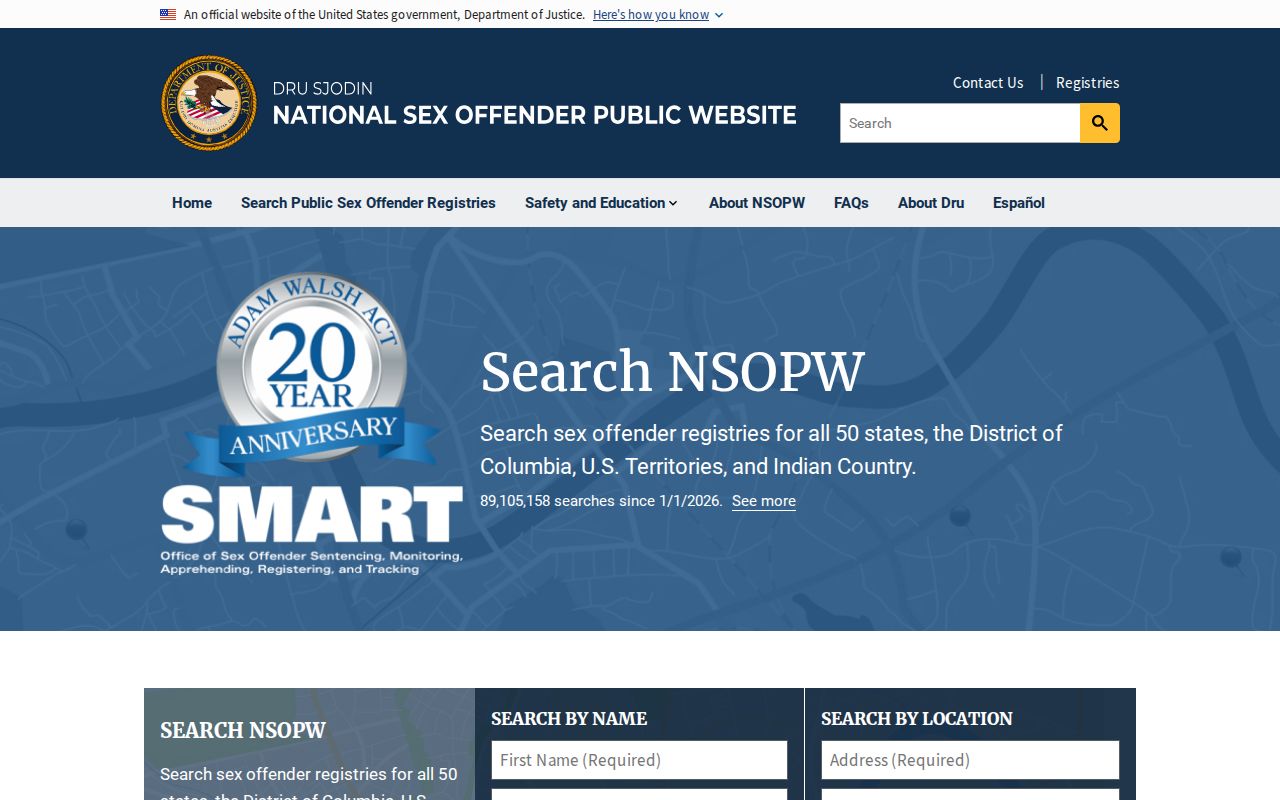
The national view adds geographic reach, while the New Jersey registry remains the better source for the state's warnings, profile details, and local reporting route.
Compare the responsible jurisdiction and update date. Similar names in different states do not establish that profiles describe the same person. If NSOPW routes back to New Jersey, read the state profile and its conditions rather than relying only on the national result summary.
Registration Levels and Duties in New Jersey
New Jersey describes registrants through risk tiers. Tier 1 is low risk, Tier 2 is moderate risk, and Tier 3 is high risk. Those terms govern the reach of community notification. They are not the federal SORNA shorthand of ten years, twenty-five years, or life. Registration length depends on the offense and governing statute, not the tier label alone.
| Risk Tier | Notification Concept | Duration Caution |
|---|---|---|
| Tier 1, low | Law-enforcement notification | Duration depends on offense and statute |
| Tier 2, moderate | Law enforcement plus qualifying schools and organizations | Internet inclusion follows separate statutory criteria |
| Tier 3, high | Broad notice to members of the public likely to encounter the registrant | Many serious offenses carry lifetime duties; relief requires legal review |
N.J.S.A. 2C:7-2 has historically allowed some registrants to seek termination after fifteen offense-free years by proving they are not likely to threaten others. Lifetime, juvenile, and later statutory categories carry exceptions. No one should infer eligibility from an Essex County registry tier or the passage of time alone.
Correcting Essex County Registry Information
If an Essex County profile seems to show a wrong address or status, preserve the record URL, the date viewed, and the specific field at issue. Do not visit the address or confront anyone. Report the concern to the Essex County Prosecutor's Megan's Law function or the local police department responsible for that municipality. State Police manages the Internet system, so a portal or display issue may also need the registry's correction channel.
A report should identify the observed discrepancy rather than accuse a person of a new crime. Officials can compare the public entry with information that is not open online. Use emergency channels only for immediate danger. The official process protects both public safety and the integrity of the Essex County sex offender record.
Essex County Registration Term Questions
A profile's risk tier does not answer how long registration lasts. New Jersey duration turns on the offense, date, age category, and statutes that apply. The historical fifteen-year petition route has conditions and exceptions, and many serious offenses carry lifetime registration. Public Internet inclusion is another distinct question.
For that reason, a reader should not mark a profile as overdue for removal based on tier alone. A court decides a proper petition, and registry agencies update the official record after lawful relief. The public Essex County lookup should be read as it exists now, with its update date and status, not as a prediction about future eligibility.
Note: New Jersey risk tiers measure notification risk and cannot be converted into the federal ten-year, twenty-five-year, and lifetime labels.
Using Registry Information Lawfully
The Essex County registry is an awareness and safety tool. It can help a family understand public information about a neighborhood or help a community member route a real concern to the right agency. It does not authorize threats, intimidation, harassment, surveillance, or confrontation. A listing is also not proof that a person has committed a new act.
Misuse is a crime: N.J.S.A. 2C:7-14 forbids threats, intimidation, harassment, and other misuse. Under N.J.S.A. 2C:7-16, using registry information to commit a crime can be a third-degree crime, while using it to commit a disorderly-persons or petty-disorderly-persons offense is punishable.
Community notice follows rules set by New Jersey law. If a profile raises a sound concern, use the correction or law-enforcement channel. For broader county criminal record context, the Essex County criminal history overview separates court, arrest, custody, and state repository records.